

Building a System: Tool for Time Management (2)
I’ve previously spoken about some important pillars of time management in terms of mindset and useful tools. However, I find that it can be quite hard to keep track of every moving part in my life. That is why I created the following ‘worksheets’ to fill in (on Sunday/at the start of the week/whenever it works for you) to help you stay on top of your workload.
Page 1: ‘All Tasks’
The first page is meant to be a brain dump of all tasks that need to get done this week. This can (and will probably) be messy. That is no problem, just get everything out of your head and onto the paper. The next pages will be about organizing all tasks.
Page 2: ‘Priority Matrix’
The idea of a ‘priority matrix’ stems from former US president Dwight D. Eisenhower. He developed this time-management tool to set priorities, improve focus and reduce stress. His original matrix consisted of the following four quadrants:
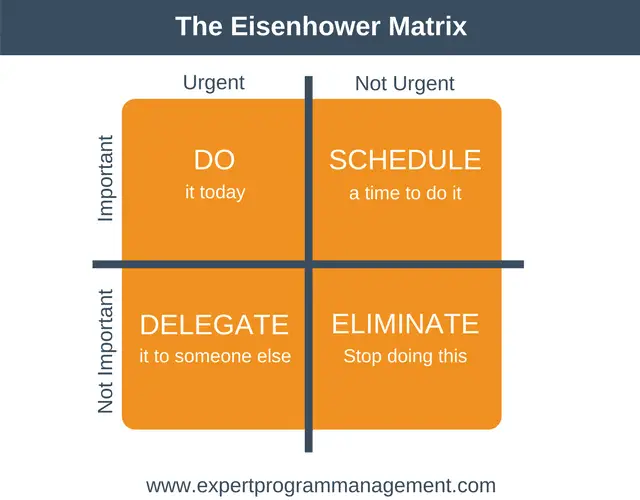
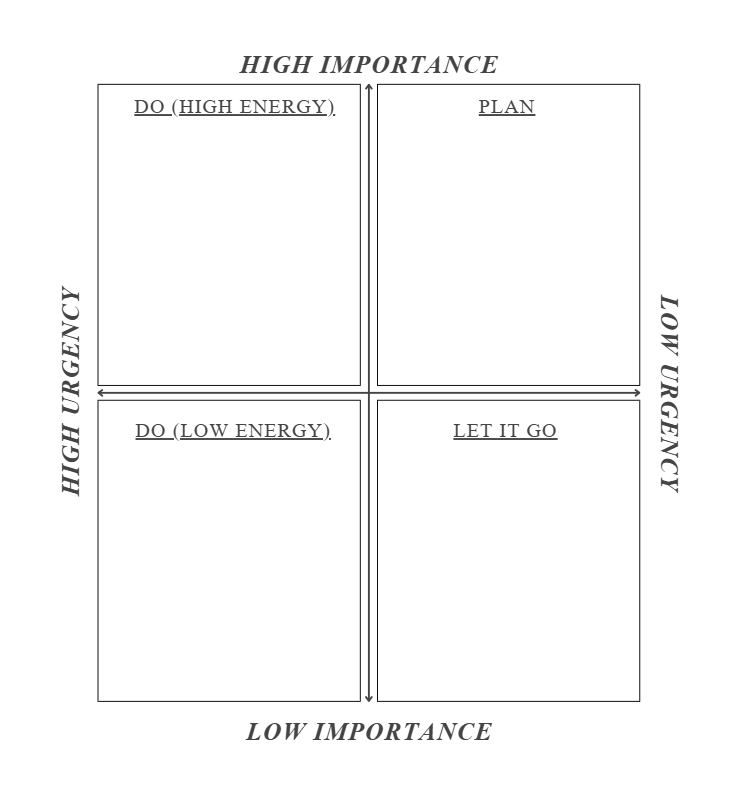
I really like the underlying idea of this matrix, but I have a few remarks. That’s why, for my own planning, I modified it:
- ‘(Not) important / (not) urgent’ → ‘high/low importance / high/low urgency’: To speak for myself, there are few tasks that have no importance or urgency whatsoever. This is why I changed this to a sliding scale.
- ‘Delegate’ → ‘Do (low energy)’: Delegating is very often not a possibility. That is why I changed it to ‘low energy’. By this, I mean that these tasks should be scheduled at moments where you are tired or less motivated. Of course, if these can be delegated (or automated), that’s even better.
- ‘Eliminate’ → ‘Let it go’: As eliminating tasks is not always desirable, I titled this section ‘Let it go’, to signify that you should be content with postponing (or actually deleting) the task if you don’t get it done this week.
Page 3&4: ‘Daily Actions’
This is where you start planning the week ahead, this can be supplemented or substituted with time blocking (in a calendar app). This spread is intended to be used as a daily to-do list, so I recommend adding boxes that can be checked off or highlighting/crossing out when tasks are finished. Additionally, I added a deadline section. This section can be combined with the previous priority matrix by adding abbreviations for ‘Do (low/high energy)/plan/let it go’.
Leave a Reply